



Last updated: November 19, 2026
A veneer covers the visible front of a tooth mainly to improve its appearance; a crown covers the tooth all around when it needs more structural protection. In the dental crowns vs veneers decision, a conservative veneer generally preserves more natural enamel, but the right choice depends on how sound the tooth is.
What is the difference between dental crowns and veneers?
A veneer covers the visible front of a natural tooth, while a crown surrounds the prepared tooth. The American Dental Association’s veneer guidance explains this distinction. A crown can also anchor a bridge or replace the visible part of a missing tooth on a dental implant. A large cavity may leave too little natural tooth to hold a filling. When a natural tooth is prepared for either restoration, removed enamel will not grow back.
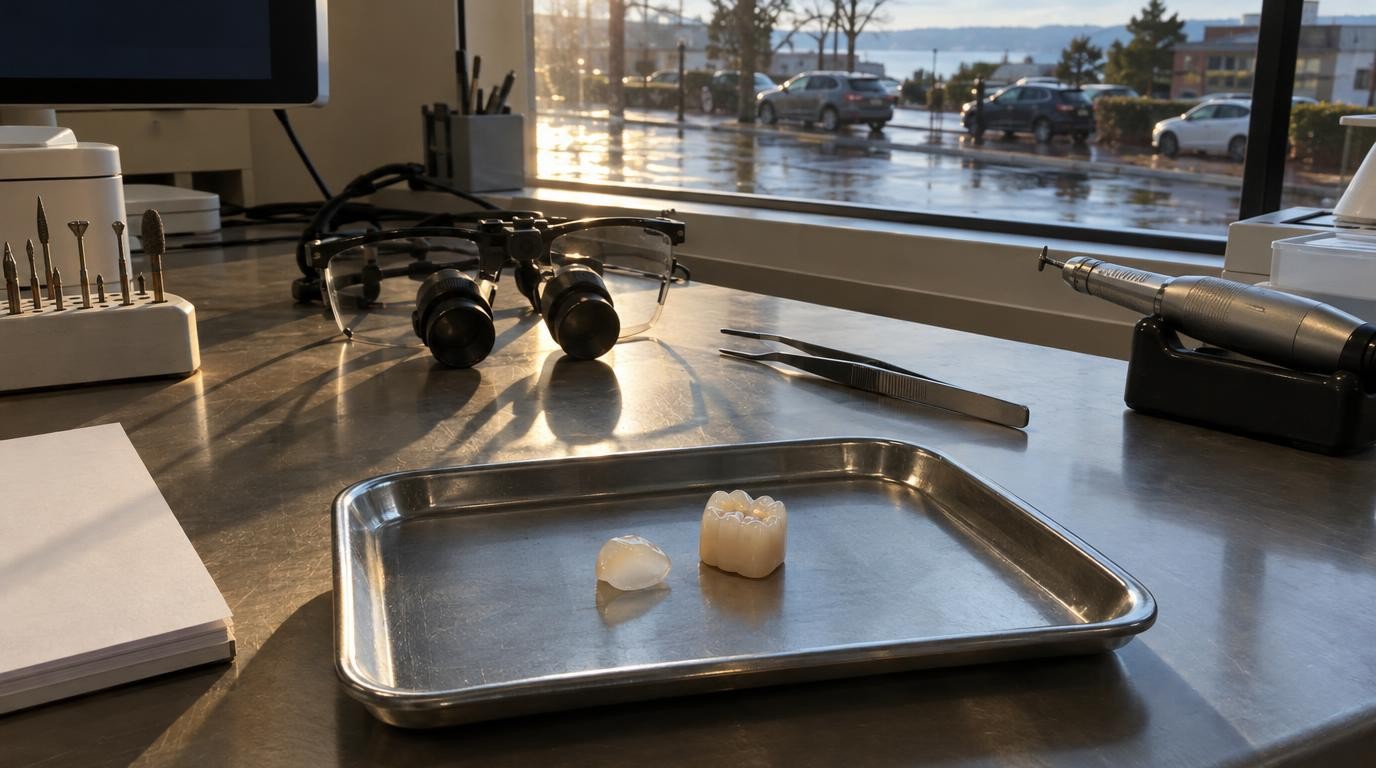
For a natural tooth, the main differences are:
| Consideration | Veneer | Crown |
|---|---|---|
| Coverage | Covers the visible front of the tooth | Covers the prepared tooth all around |
| Main use | Improves the appearance of a tooth suitable for bonding | Restores or protects a weakened tooth and can improve its appearance |
| Preparation | Usually removes a small amount of enamel from the front and sides | Reshapes more of the tooth to fit full coverage |
| Materials | Porcelain or composite | Options include metal, resin, ceramic, and porcelain-fused-to-metal |
How much of a tooth does each restoration cover?
A veneer generally leaves the back and biting surface of the tooth uncovered; a crown extends over those surfaces. At Good Tooth Dental Care, our porcelain and composite veneers are thin coverings customized to improve a tooth’s color and shape.
Which option removes more natural tooth structure?
A conservatively prepared veneer typically requires less enamel removal than a full crown because it covers less of the tooth. Preparation varies with the tooth’s shape, existing damage, and restoration material; a veneer is not automatically a no-preparation treatment. The goal is to preserve sound tooth structure without leaving a weakened tooth underprotected.
When is a veneer a better fit than a crown?
A veneer may be a better fit when a front tooth is healthy enough to support bonding and the main concern is its appearance. Porcelain and composite veneers can change visible color, shape, size, and apparent alignment.
Even when appearance is the main concern, a crown may be more effective for moderate to severe discoloration of a single tooth, according to the American Dental Association’s discussion of single-tooth discoloration. A crown removes more original tooth structure and may carry a greater risk of complications, so we consider less extensive options first when they could meet your needs.
For example, whitening may suit discoloration that responds to bleaching; bonding may suit a minor chip or small gap; and clear aligners may address tooth position rather than masking it. A filling may be enough for limited damage or decay. The American Dental Association’s smile-improvement guide describes whitening and bonding. We offer teeth whitening, clear aligners, and dental fillings, and can discuss which option suits your tooth after an examination.
Can veneers help with stains, chips, gaps, or uneven front teeth?
Veneers can mask stubborn tooth stains and improve the look of small chips, gaps, worn edges, misshapen teeth, or mild unevenness. The amount of damage matters: a small chip may be suitable for a front-surface restoration, while a substantial break may need another approach. Our guide to front-tooth damage and discoloration explains other considerations for visible teeth.
How much healthy enamel does a veneer need?
There is no single enamel requirement that fits every tooth. A dentist assesses whether enough sound enamel remains for a reliable bond and whether the bite will place excessive force on the veneer. If decay, an old restoration, or wear has substantially reduced that bonding surface, preserving more tooth through a veneer may not produce the most dependable result.
When does a tooth need a crown instead of a veneer?
A tooth may need a crown when decay, a large existing filling, a substantial fracture, or lost tooth structure makes front-surface coverage inadequate. A crown surrounds the prepared tooth to provide broader support. A crack requires individual assessment because its depth and location affect whether a crown, another restoration, or different treatment is appropriate.
Can a veneer protect a badly cracked or weakened tooth?
No. A veneer cannot fully protect a badly cracked or weakened tooth because it does not surround it. MedlinePlus guidance on dental crowns identifies weak, broken, worn, and cracked teeth among reasons a crown may be used. An examination helps establish whether the remaining tooth can be restored and how much coverage it needs. Our guide to dental crowns offers more detail on tooth restoration.
Why do dentists push for crowns?
A recommendation for a crown should be based on the tooth’s condition, not assumed motives. Ask what damage full coverage addresses, how much sound tooth remains, and whether a more conservative filling or other restoration would protect it adequately. If the tooth truly needs broader support, choosing a veneer simply to remove less enamel could leave the underlying problem unresolved.
How long do veneers and crowns last?
Veneers and crowns can serve for years, but neither has a guaranteed lifespan. The remaining tooth, bite forces, placement, restoration material, and daily care all influence how long either restoration lasts.
The reviews below report veneer outcomes:
| Source | Evidence and finding |
|---|---|
| Clinical Survival Rate and Laboratory Failure of Dental Veneers: A Narrative Literature Review | The 2024 narrative review reported veneer survival generally above 90% for more than 10 years. |
| Survival Rates for Porcelain Laminate Veneers: A Systematic Review | The 2021 systematic review selected 30 clinical studies reporting Kaplan-Meier survival estimates. It found generally high success rates for porcelain laminate veneers but could not establish their longevity beyond 20 years. |
A prospective study of lithium-disilicate crowns cited by the American Dental Association’s materials review reported 97.4% crown survival after five years and 94.8% after eight years; replacement counted as failure. That crown study and the veneer reviews are not head-to-head comparisons, so their results cannot establish which option will last longer for you.
Does preserving enamel help veneers last longer?
Yes. The narrative review found that retaining enamel was important to veneer survival and that glass-ceramic veneers with minimal or no preparation had the highest survival rates among the approaches it considered. That finding supports tooth enamel preservation when a veneer is appropriate; it does not mean every tooth can safely receive a veneer without preparation.
What causes a veneer to fail?
Fracture was the main failure mechanism in the narrative review, followed by a veneer coming loose and color change. The review also associated fractures with clenching or grinding. A dentist therefore considers both the bonding surface and how the upper and lower teeth meet, rather than judging durability by the veneer material alone.
What are the downsides and risks of veneers and crowns?
When enamel is removed for a veneer or crown, it cannot grow back, and either restoration may eventually need repair or replacement. A crowned tooth can become sensitive to hot or cold; nerve problems sometimes require further treatment.
What are the downsides of dental crowns?
Fitting a crown generally removes more natural tooth structure than fitting a veneer on a sound tooth. Material choice brings other trade-offs: resin crowns can wear down or crack more readily, while metal crowns withstand chewing but do not match natural tooth color. Ceramic or porcelain crowns can match nearby teeth but can chip or crack; MedlinePlus notes that they can wear opposing teeth more than metal crowns. The ADA’s materials review cites a systematic review that reported a 2.6% five-year rate of chipping of the porcelain facing on porcelain-fused-to-metal crowns. That figure is not a chipping rate for all crowns or for dental veneers.
Can a tooth still rot under a crown?
Yes. Decay can develop in the natural tooth at a crown’s edge if plaque accumulates or the margin no longer fits well. A cavity can also form under or around a veneer. Neither covering makes a tooth decay-proof, which is why cleaning around restoration margins and attending routine examinations remain important.
Who should wait before getting a veneer or crown?
Untreated decay or gum disease should be addressed before a cosmetic veneer is placed. Limited enamel, a deep bite, or unmanaged clenching and grinding may also make veneer bonding or survival less predictable; these factors need assessment before choosing either restoration. Discuss those conditions, along with any pain or suspected crack, with your own clinician before deciding on treatment. Call your dentist promptly if swelling worsens or tooth pain is not relieved by over-the-counter medicine. Seek emergency care if you have trouble breathing or swallowing.
What happens during veneer or crown treatment, and what is recovery like?
Veneer and crown treatment begins with an assessment of the tooth, bite, and desired appearance. The main steps are:
- Choose a suitable restoration and, for a tooth-colored option, a shade.
- Remove decay or failing fillings if needed and prepare the tooth.
- Make or commission the restoration: composite veneers are shaped directly on the tooth, while porcelain veneers and many crowns are made using an impression or digital scan.
- Check the restoration and bite, then bond a veneer or cement a crown in place.
Temporary sensitivity is possible, and recovery varies by tooth and treatment.
How are porcelain and composite veneers placed?
A porcelain veneer usually requires removing a small amount of enamel from the front and sides before a custom shell is made. You may wear a temporary veneer while it is being made. Composite material is bonded directly to the tooth, then shaped and polished; it may require less enamel removal and fewer visits. Our veneer procedure guide explains the treatment sequence in more detail.
How is a crown fitted differently?
A crown requires preparation around the tooth rather than primarily on its front surface. Getting a conventional crown usually takes two visits. At the first, the dentist numbs the tooth and nearby teeth and gums, removes decay or failing fillings as needed, reshapes the tooth, and takes an impression or digital scan. You typically wear a temporary crown while a lab makes the permanent one. At the second visit, the dentist checks the fit and bite, may take an X-ray, and cements the crown. Some dentists can instead make a crown in the office using a digital scan.
How long can sensitivity last after treatment?
Some temporary sensitivity can follow tooth preparation or placement, but there is no reliable single recovery time for every patient. The American Dental Association says getting used to a veneer may take a few days; that adjustment is different from how long sensitivity lasts. Call the treating dentist if pain persists or increases, a restoration feels loose, or your bite feels uncomfortable after placement. The tooth or bite may need evaluation.
Will veneers or crowns look natural on front teeth?
Veneers and crowns can be made to blend with nearby front teeth by selecting an appropriate shade, shape, and size. Veneers primarily address the visible appearance of a sound tooth, while crowns can combine a natural-looking finish with structural coverage. The result depends on the starting tooth, neighboring teeth, and restoration design.
How do dentists match a veneer or crown to nearby teeth?
Shade selection considers more than whether a tooth looks white: neighboring teeth provide a reference for color, contours, and proportions. A dentist also checks how the planned restoration sits beside adjacent teeth when you smile. Porcelain veneers at Good Tooth Dental Care are customized for the individual tooth and smile; no restoration can be promised to look identical in every case.
Do porcelain veneers resist staining?
Porcelain veneers are stain-resistant, not stain-proof. Our porcelain veneers are designed to maintain their appearance with proper care, but stains can still affect nearby natural teeth and the appearance of the smile as a whole. Composite veneers are generally less resistant to staining and wear than porcelain, so material choice is part of the aesthetic discussion.
How do you care for veneers and crowns after treatment?
Keep routine dental visits, and avoid biting your fingernails or chewing hard objects with restored teeth. If you clench or grind your teeth, a night guard may help protect a crown; grinding can make veneers a poor fit.

Can brushing and flossing help protect the tooth underneath?
Yes. Brushing and cleaning between teeth help remove plaque where a restoration meets natural tooth. The American Dental Association recommends brushing with fluoride toothpaste twice a day and cleaning between teeth daily in its veneer care guidance.
What should you do if a veneer chips or a crown feels loose?
Contact the treating dentist so the restoration and underlying tooth can be checked. A chip may be repairable, while a loose crown or veneer may need to be secured again or replaced after its cause is assessed. Do not try to glue it back on at home, and avoid biting on the affected tooth until it has been evaluated.
Frequently Asked Questions
Do celebrities have veneers or crowns?
Some celebrities may have veneers or crowns, but a photograph cannot reliably show which treatment someone has had. Both can look like natural teeth. A veneer covers the front of a tooth, while a crown covers it more fully. The appropriate choice depends on the tooth’s condition, not the look of someone else’s smile.
Do composite veneers require less enamel removal than porcelain veneers?
According to the American Dental Association, composite veneers may require less enamel removal than porcelain veneers. They may also take fewer visits and be easier to repair, but they are less resistant to staining and wear. At Good Tooth Dental Care, we offer both materials and tailor preparation to the tooth.
Does getting a dental crown mean you need a root canal?
No, getting a crown does not automatically mean you need a root canal. A crown covers and supports a prepared tooth; a root canal may be needed if the tooth’s nerve is affected, according to MedlinePlus. Your dentist must evaluate the tooth to determine whether nerve treatment is necessary.
How should I care for a temporary crown?
While you have a temporary crown, slide floss out from between your teeth rather than lifting it up, avoid sticky foods, and try to chew on the other side of your mouth. These precautions can help keep the temporary crown in place until your permanent one is fitted. Contact your dentist if it comes off.
Can veneers be placed on lower front teeth?
Yes, lower front teeth can receive veneers when they have enough suitable tooth structure and the bite allows it. The 2024 narrative review reported no difference in veneer survival between upper and lower teeth. That finding does not establish whether a particular lower tooth is suitable; a dentist needs to check its enamel and bite.
Do I need a mouthguard for sports if I have veneers?
Yes, wear a mouthguard if you play a sport or do an activity that could injure your mouth. The American Dental Association recommends this as part of veneer care. A mouthguard helps protect against injury, but it does not make a veneer unbreakable. Ask your dentist what type fits your activity.
Why might a crown fall off even if the crown is not broken?
A crown can fall off if the remaining tooth structure holding it in place is too weak, according to MedlinePlus. A detached crown needs an examination of both the restoration and the tooth beneath it. Contact your dentist rather than gluing it back on yourself, because the underlying cause needs to be assessed.
How can Hunts Point patients choose between a veneer and a crown?
Choose between a veneer and a crown by starting with the tooth’s needs, not the appearance of the finished restoration. A sound tooth with a cosmetic concern may be suited to a conservative veneer; a significantly weakened tooth may need a crown. Remaining enamel, bite forces, and expected upkeep help determine which option preserves healthy tooth appropriately.
What should you ask at a Bellevue dental consultation?
- Is the main concern cosmetic, or does the tooth need structural protection?
- How much sound enamel and other tooth structure remain?
- Could grinding or the way the teeth meet affect the restoration?
- What maintenance or future repair might each suitable option involve?
- Is a more conservative restoration appropriate without compromising the tooth?
For patients coming from Hunts Point, Washington, our office is at 4122 Factoria Blvd SE, Suite 301, in Bellevue. We offer porcelain and composite veneers and can assess whether a crown would better protect a weakened tooth. Call 425-401-5000 to request a consultation; our office hours are 10:00 a.m. to 6:30 p.m. Monday, Thursday, and Friday.
This information is general and is not medical advice. Talk to a licensed clinician about your own situation before making a treatment decision.
